

Standardizing
Purchase Flows
OVERVIEW
Shortly after joining the Diablo Immortal team, it became clear that certain mobile purchasing standards were not being met across the game.
With existing momentum behind our Product team’s ongoing economy and monetization initiatives, I partnered closely with them to identify additional areas for improvement that complimented our goals of adding currency conversion, plus fostering a trustworthy and healthy game economy.
PROBLEMS
-
The in-game Shop and various Vendors throughout the game had unnecessary friction in their purchase flows.
-
It was not always easy to understand and/or learn where to get insufficient materials needed to complete a purchase.
-
Purchase flows failed to provide alternative purchasing options, increasing the likelihood that players would not successfully complete their desired transaction.
GOALS
-
Establish a game-wide interaction and UX framework for purchase flows that would help build trust and confidence for players choosing to monetize.
-
Create a system through which players could discover how to obtain insufficient materials or currencies needed to complete a transaction.
-
Support currency conversion so players could have more purchasing options.

GLOBAL PURCHASING RULES
CONTEXTUAL CURRENCY REFILL
Supporting contextual material and currency refills instead of fully re-directing players to the in-game Shop. This way, players would not lose track of where they were in a purchase flow, and would be able to quickly return to their original task.

Option to purchase Reforge Stones directly at the Reforge Vendor.

Option to purchase Eternal Orbs at the same point-of-sale without redirecting players to the Shop.
PLAYER WALLETS
Always display relevant player wallets at points of sale. This will ensure players can compare the price of an item to their overall wallet, or see how buying multiples of an item could impact their wallet amount(s).

ERROR MESSAGING
In cases where additional purchase options cannot be provided, like when items are restricted by server stock limits or daily purchase limits, or when a purchase cannot be completed for a technical reason, error messaging should be displayed to give players proper context of the error.

BUTTON BEHAVIOR
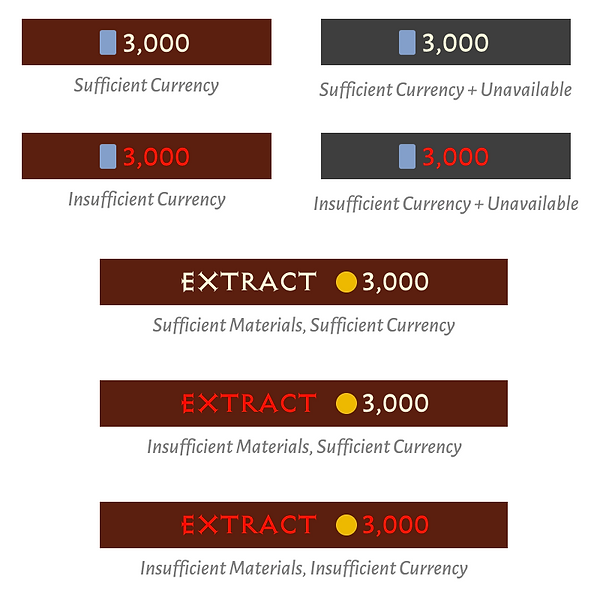
Intentionally never disabling purchase buttons so players could still discover alternative ways to complete a purchase via currency conversion or the “Get More” system (with the exception of items with purchase timers or limits).
Ensuring consistent purchase button interactions and text formatting in the in-game Shop and at all vendors.
"GET MORE" SYSTEM
To help players understand how to gain specific items, even via alternative ways that did not require spending real money, I proposed adding the “Get More” system to existing item tooltips that were already accessible during purchase flows. These dialogs would list any system or vendor through which a specific item could be obtained. It also provided an option to navigate directly to the relevant vendor, system or UI to discover more.


CURRENCY CONVERSION
Whether players attempted to purchase an item that required Platinum, but had insufficient Platinum to complete the transaction, a currency conversion option would be triggered if players had equivalent value in Eternal Orbs (the game’s hard currency) to cover the cost of the transaction. This conversion option was only made available during purchase flows.


VALIDATION
Diablo Immortal’s second public Beta test phase included real money purchases. This was our first opportunity to validate our design decisions and evaluate the health of the game’s economy in many ways. Extensive analytics collected showcased strong conversion and monetization across many different player segments. Player surveys probed for comprehension of various different systems and currencies, most of which came back positive, alluding to purchasing UX that properly supported players.
CONCLUSION
Diablo Immortal’s launch caused a lot of buzz and saw great financial success, surpassing many of the team’s original predictions at launch. The game continues to generate impressive revenue, becoming the 15th fastest mobile game to generate over $500 million in its first year. This can be attributed to many factors, including the due diligence of myself and my peers while prioritizing designing trustworthy, player-friendly purchasing experiences.